

Are you thinking about your ex constantly? Are you lying awake at 3am replaying conversations, checking their Instagram, and wondering what they're doing right now?
If that's the case, you are not alone. And — more importantly — it is not a sign that you're weak or broken.
There are specific, identifiable forces working against you from your subconscious. Forces that most breakup advice completely ignores.
I've been coaching people through breakup recovery since 2005. In that time, I've seen the same patterns repeat themselves thousands of times. And I've learned that the people who can't stop obsessing over their ex aren't doing anything wrong — they've simply never been shown what's really going on.
That's what this guide is about.
You will learn:
- The 4 real reasons you can't stop thinking about your ex
- Why conventional “get over it” advice makes things worse
- The only approach that produces lasting recovery
One important warning before we begin.
Please stop reading if you:
- Are convinced that getting your ex back is the only solution
- Are looking for a “quick fix” rather than lasting change
- Are younger than 25 — this specific approach is not designed for you
Still here? Good. Let's get to work.
What Is Really Behind This Obsessiveness?
Ask yourself honestly: What do you fear most right now?
Is it that your ex will never come back? That you'll end up alone forever? That you wasted years of your life on the wrong person?
Most people assume these fears are caused by the specific circumstances of their breakup — who left whom, what was said, what went wrong.
I've worked with thousands of people. The circumstances don't matter as much as you think. The real reasons go much deeper.
There are four forces driving this obsessiveness. Understanding them is the first step to breaking free.
Reason #1: The Paralyzing Fear of the Unknown
“The greatest fear in life is not of death, but unsolicited change.” — Raheel Farooq
Your obsessive thinking is, at its core, an attempt to avoid confronting a terrifying new reality: it's over, and the unknown is here.
Two things are happening simultaneously in your mind:
- The paralyzing fear of what comes next
- A (false) conviction that you cannot handle whatever that is
By keeping your ex alive in your thoughts — replaying memories, imagining scenarios, checking their social media — you are unconsciously postponing the moment you have to face this new reality.
It feels like you're doing something. Like you're keeping the connection alive. Like you're not giving up.
But you're not. You're hiding.
And unfortunately, the fear of the unknown is only part of what's driving this. There's more going on beneath the surface.
Reason #2: You've Been Conditioned Not to Let Go
You're surrounded by well-meaning enemies.
Society, romantic movies, popular music, close friends — they have all conditioned you to fight for love. To not give up. To believe that if you just try hard enough, love conquers all.
Search for “how to get over a breakup” online and most of what you'll find is advice on how to get your ex back. The messaging is everywhere: hold on, don't quit, they might come back.
This conditioning creates a painful gap between what your gut is telling you and what everyone around you is saying.
And that gap — that desperate, aching gap — is what fuels the obsessive thinking. The obsessing is your mind's attempt to fill a void left by their absence.
But like any addiction (and we'll get to why this is literally an addiction in a moment), the more you feed it, the worse it gets.
“Lots of things can be fixed. But many times, relationships between people cannot be fixed, because they should not be fixed. You're aboard a ship setting sail, and the other person has boarding a different ship, and you just can't be with each other anymore. Because you shouldn't be.” — C. JoyBell C.
Consider Linda's story.
Linda was in an on-and-off relationship with her ex for nearly four years. Every breakup was followed by a severe depression, where she would desperately try to get him back. Every reconciliation felt euphoric — like the pain had finally lifted.
But every single time, reality would catch up. The euphoria would subside. The same problems would return. And after four years of breakups and reconciliations, they were forced to face an undeniable truth: they had been incompatible all along.
Research on this is clear. A large percentage of couples who reconcile break up again within a short period. As one professor of family studies at Kansas State University concluded:
“In real life, as much as it hurts, maybe there are relationships that are better off left as memories.”
I know that's painful to read. I'm not saying it to hurt you. I'm saying it because I've watched too many people waste years of their life on the wrong person — and I don't want that for you.
The hardest truth you need to accept is this: your ex is not the right partner for you. If they can leave, let them go.
Reason #3: You're Dealing With a Real Addiction
This is not a metaphor. Pining over an ex has been proven by studies to function identically to addiction.
You crave the presence of your ex the way an addict craves a drug.
Since you can't have the real thing, your mind creates a substitute — a mental rendezvous with your ex. Replaying conversations. Imagining reconciliation. Stalking their social media. This is your methadone.
And like any addiction, it provides momentary relief while making the underlying problem worse.
Here's what makes this so insidious: every time you give in to the obsessive thought — every time you check their Instagram, every time you replay that argument — you reinforce the neural pathway. You make it harder to stop next time.
This is why willpower alone doesn't work. You cannot simply “decide” to stop thinking about someone when your brain has wired this behavior as a survival mechanism.
You have to treat it like an addiction. Which means addressing the root cause — not just the symptoms.
Reason #4: Your Hidden Core Pain-Points
This is the deepest layer, and the most important one.
When people continue to suffer disproportionately after a breakup — when the grief seems out of proportion to the relationship itself — the reasons are almost always more profound than the breakup alone.
Something you have been carrying your entire life gets activated, and takes over your behavior.
I call these “Hidden Core Pain-Points.”
These are negative or toxic belief systems that developed from experiences in your childhood or early adulthood. Not necessarily trauma or abuse — sometimes it's simply early memories, behaviors observed in your parents, or formative experiences that shaped your beliefs about love and relationships.
Here are some real examples from people I've worked with:
- Don was accidentally trapped on a bus as a five-year-old while his mother stood outside and watched him be taken away. He grew up with a deep fear of abandonment.
- Anne was constantly teased in school for being different. She grew up hating the very things that made her special — and unable to accept love from others because she couldn't accept herself.
- Eddie had an overly authoritative father who crushed every autonomous tendency in him. (That's me.) I spent years trying to compensate for deep insecurities through my relationships.
And then there's Rachel.
Rachel had a difficult childhood — not abuse, but the constant spectacle of a dysfunctional marriage. Her parents argued daily. And almost every month after a big fight, her father would pack a suitcase and disappear for a week.
Rachel grew up carrying a deep, subconscious fear that the person she loved would always leave. That fear followed her into every relationship she ever had — and exploded with full force after her divorce.
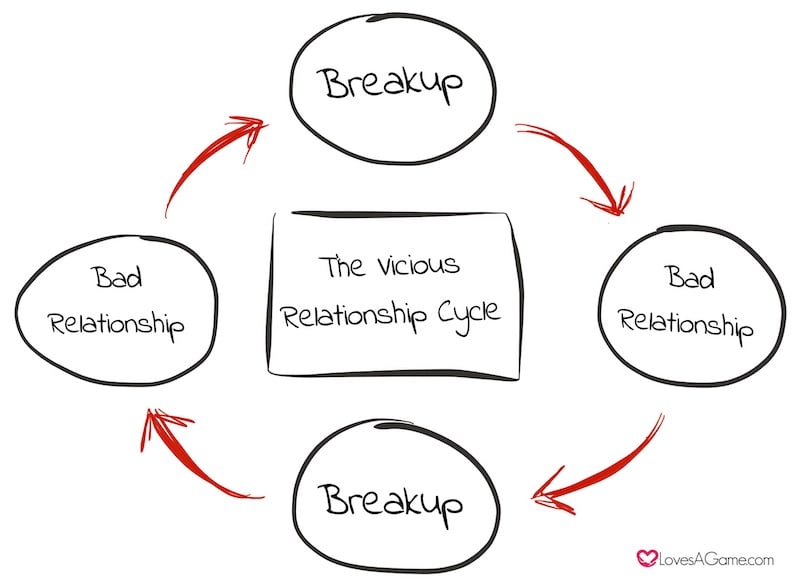
Here is the critical thing to understand: these hidden pain-points are the reason most of us repeat the same toxic relationship patterns throughout our lives. We don't choose the same type of partner consciously. We're drawn to familiar dynamics that match our unresolved wounds.
Will Time Heal This?
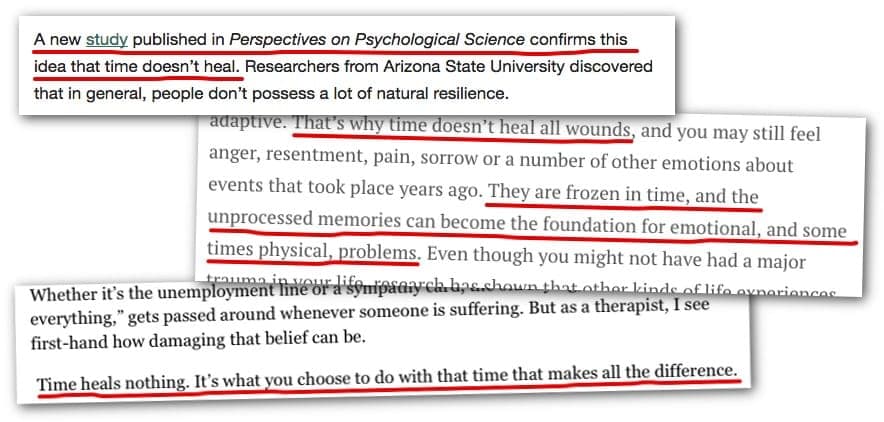
No. And this is where most people get it badly wrong.
Time does not heal hidden core pain-points. Your wounds will still be there in five years, in ten years — and they will continue to quietly sabotage your relationships and your life.
But here's the other side of this: when you do identify and resolve these pain-points, something remarkable happens. All the post-breakup symptoms you're experiencing right now — the obsessive thinking, the inability to sleep, the constant longing — begin to slowly fall away.
Because you've addressed the source, not just the symptom.
The Solution: A Holistic Healing Approach
Let me summarize what you've learned:
- Your breakup has triggered a deep fear of the unknown — and the false belief that you can't handle what's coming.
- You've been conditioned by society to not let go, creating an agonizing gap between what your gut knows and what you've been told.
- The obsessive thinking is a real addiction — not a sign of love, but a neurological response that must be treated as such.
- Beneath all of it are hidden core pain-points that have ruled your relationship life until now.
- Time alone will not heal any of this sustainably.
So what is the solution?
A holistic healing approach — one that works on all levels simultaneously:
- Treat the symptoms — stop the obsessive thinking, reduce the immediate pain
- Break the addiction to your ex through structured No Contact
- Identify and resolve your unique Hidden Core Pain-Points
- Reconnect with yourself — who you are outside of this relationship
- Bulletproof your heart so this doesn't happen again
This is not a quick fix. It's a recovery plan — one that produces lasting change instead of temporary relief.
Take a shortcut, heal partially, and you will find yourself in this same place again. Maybe you already have, more than once.
It's time to break the cycle for good.
“These daily emails are speaking to my soul at a time when I need them most. Thank you!” — Jacqueline
“Your emails are the only reason I don't cave and text my ex. Thank you.” — Jennifer
“I am about 90% now vs. the 30% I was before I found your website.” — Lisa
Your Next Step: Start Your Recovery Today
If you're serious about breaking free from your ex and healing in a way that actually lasts, I want to walk you through the first steps — at no cost.
I usually charge $250/hour for one-on-one coaching. But I've built a free email mini-course that covers the core principles of sustainable breakup recovery — and I want to send it to you.
Here's what you'll learn:
- A practical solution that eliminates 90% of your immediate problems
- A proven technique to stop the obsessive thinking — starting today
- How to cut your healing time from years to 60 days
- How to identify and resolve your hidden core pain-points
Click the button below to start for free:
Send Me Lesson #1 (Free)No spam. No obligation. Unsubscribe at any time.
Already past the basics and ready for the full system? Learn about the Ex-DETOX Course — the complete 60-day breakup recovery program.
Not sure where you are in your healing? Take the free Breakup Healing Test to find out how long your recovery will take — and how to speed it up.